
Guncrafter Industries
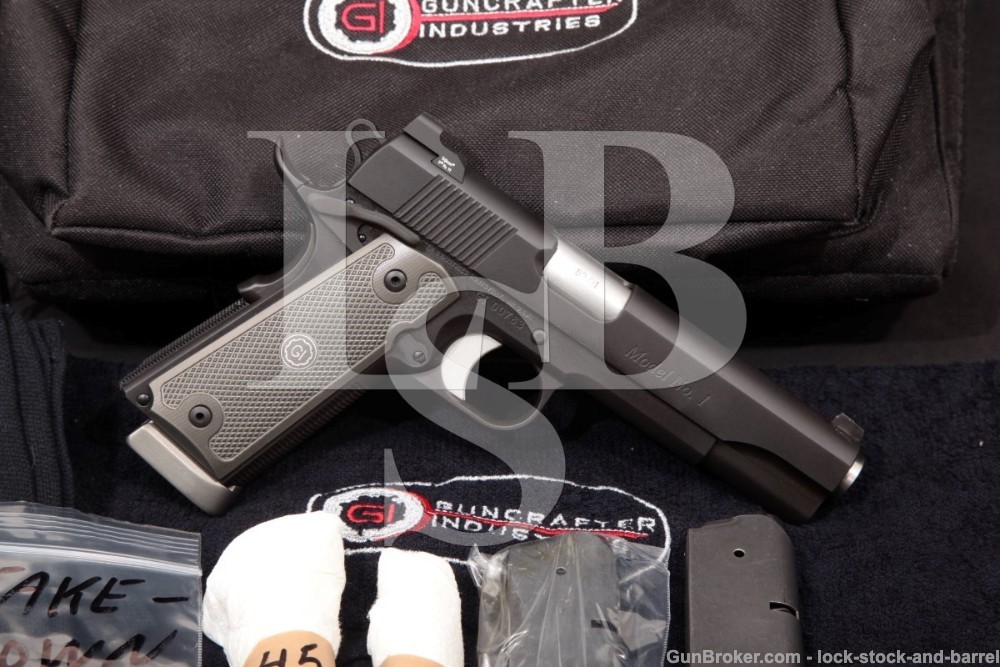
Guncrafter's founder left the top engineering job at Wilson Combat to build a 1911 around a cartridge of his own design — the .50 GI, a half-inch bullet with .45 ACP manners.
THE MAKER
Alex Zimmermann was not a Wilson Combat shop hand who dreamed bigger. He was the company's Director of R&D and head of engineering — and an IDPA champion besides — when he left in 2004 to found Guncrafter Industries in Huntsville, Arkansas. The reason was a cartridge. Zimmermann had designed a round Wilson wasn't going to build a company around, so he built the company himself.
The postscript arrived twenty-two years later. In 2026, Wilson Combat acquired Guncrafter Industries, with Zimmermann staying on in an advisory and developmental role, as American Rifleman reported. The engineer who walked out to compete with the giant now designs inside it again — with his own brand, his own models and his half-inch cartridge intact.
THE MACHINE
The cartridge is the .50 GI: a half-inch-diameter bullet — the standard load runs about 300 grains at roughly 700 feet per second, which is .45 ACP velocity wearing a much wider hat. The design goal was never magnum drama. It was the opposite: a bigger, heavier hole at pressures and recoil a 1911 handles comfortably. Guncrafter's pistols chamber it natively and convert back to .45 ACP with a barrel and recoil-spring swap, so the exotic caliber never strands its owner.
The model names are the plainest in the custom world: No. 1 is the standard Government-size gun, No. 2 adds the full-length dust cover and rail, No. 3 is the Commander, No. 4 the long-slide, No. 5 the Officer's-size. No mythology, no acronyms — just numbers, in size order, like a man numbering his prototypes and never bothering to rename them.
THE MOMENT
Every industry has a boomerang story; the custom 1911 world's is dated 2026. Zimmermann leaves Wilson as its top engineer, spends two decades building the company that proves his cartridge idea, and then Wilson buys the company and hands him a design role. Nothing about it reads as defeat — American Rifleman's account has him staying on to develop — it reads as the industry's oldest truth: there are only so many men who can engineer a 1911 at this level, and eventually they all seem to work in the same few Arkansas towns.
The .50 GI, meanwhile, remains what it was designed to be: a cartridge that exists because one engineer wanted it to, sustained for twenty years by one small company in Huntsville.