
Ned Christiansen
Ned Christiansen spent two decades engineering plastic injection molds before turning the same mind on the 1911 — his grip texture alone required a cutter that didn't exist.
THE MAKER
Ned Christiansen's shop is Michiguns Ltd., in Three Rivers, Michigan, and his biography is the most unusual in this series: before pistolsmithing, he spent more than twenty years as an engineer in plastic injection molding — designing molds and precision parts for phones, cameras, cars and defense programs, collecting patents along the way, a few of them gun-related. He came to the trade with a competitor's history too: action shooting since the 1970s, IPSC from 1984, and a first place at the 1984 World Shotgun Slug Championship.
The shop runs as a one-man operation — recently joined by an apprentice, Valo — quoting each job individually, because Christiansen's stated position is that package deals disqualify work as truly custom. He is, like Rogers and Chen, a founding member of the Louder Than Words consortium.
THE MACHINE
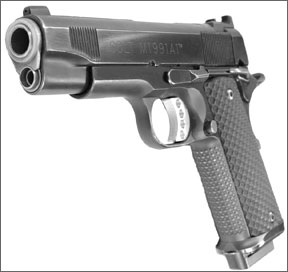
His signature is the Conamyds: where other smiths cut pyramids — checkering — Christiansen machines cones. Gun Tests counted 119 of them in one Commander's front strap, each flat-topped so it grips without cutting, with a tiny diamond between each cone, all cut with a special tool, fixture and process he built for the purpose because no existing tooling made the shape he wanted. The pattern repeats across the mainspring housing — which he machines from scratch — the slide stop, even the tip of the magazine release.
The engineering shows in the inventions around the texture: the Shield-Driver rear sight, whose ledge is designed to rack the slide one-handed against a belt, holster or door frame; the FallArrest hammer-and-safety part set; and a pistol he built for writer Patrick Sweeney that still gets cited — a Titanium Commander in 9mm, Caspian slide on a titanium frame, wearing all of the above.
THE MOMENT
The build that captures Christiansen arrived as a wreck of history: a 1911 that had left Colt in 1924, showing up in 2009 with its finish mostly gone and minor pitting. Most smiths would have restored it to period. Christiansen, per Patrick Sweeney's account in Gun Digest's 1911: The First 100 Years, made it “Real, not Retro” — tightened throughout, fitted with high-visibility sights of a kind that would not have been outrageous in 1924, a low-profile lanyard loop, and polished to the standard of 1924: perfect.
The numbers from the era when Gun Tests profiled the shop tell the demand side: in 2009 a Michiguns Commander ran about $5,000 with a five-to-six-year wait — and the magazine's conclusion was that he wasn't charging enough.