Cabot Guns
Cabot machines 1911s the way aerospace shops machine jet parts — then builds them out of Damascus steel, and once, out of a meteorite older than the Earth itself.
THE MAKER
Cabot Guns was founded in 2011 by Rob Bianchin, whose first careers were in banking and software, not gunmaking. Headquarters sit in the small Pennsylvania town the company is named for; the guns themselves are manufactured in Fort Wayne, Indiana. Bianchin built the company like an aerospace contractor that happens to make pistols: every dimension on a drawing, every part machined from solid stock, every process repeatable.
That background produced the company's signature idea, Clone Technology: Cabot machines its frames and slides so precisely — the company cites slide-to-frame clearances held to a thousandth of an inch — that parts are effectively interchangeable between guns without hand fitting. It is the philosophical opposite of the traditional custom shop, where parts are married to one gun forever. Cabot set out to prove a machine could hold the tolerances a master's file used to.
THE MACHINE
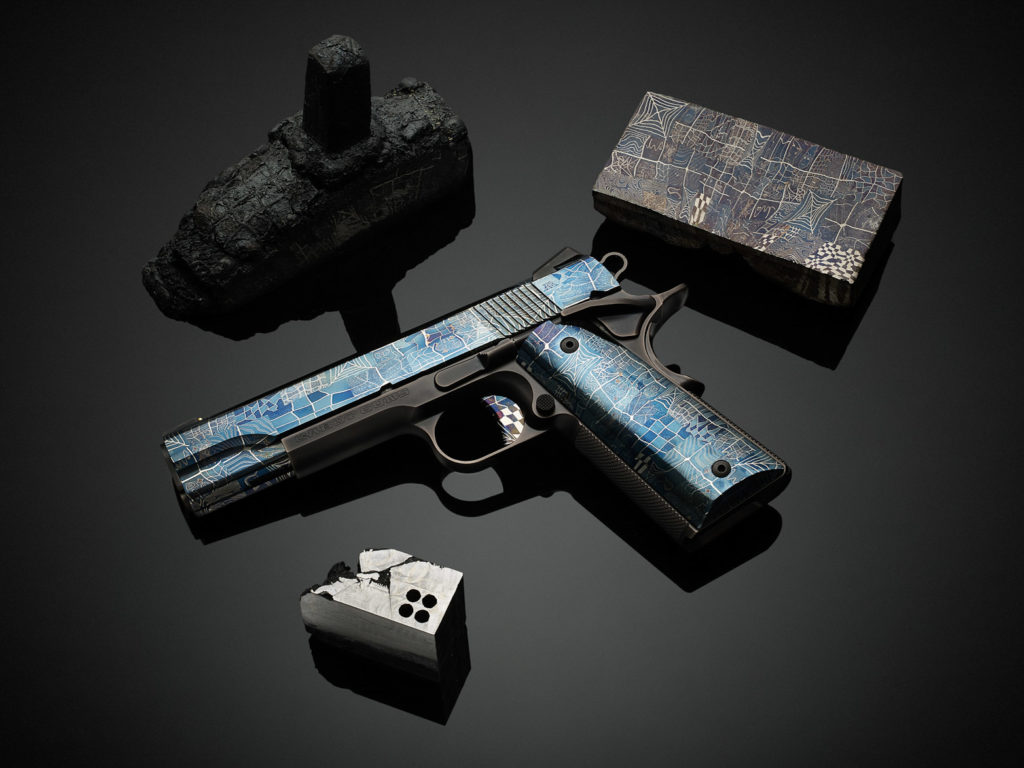
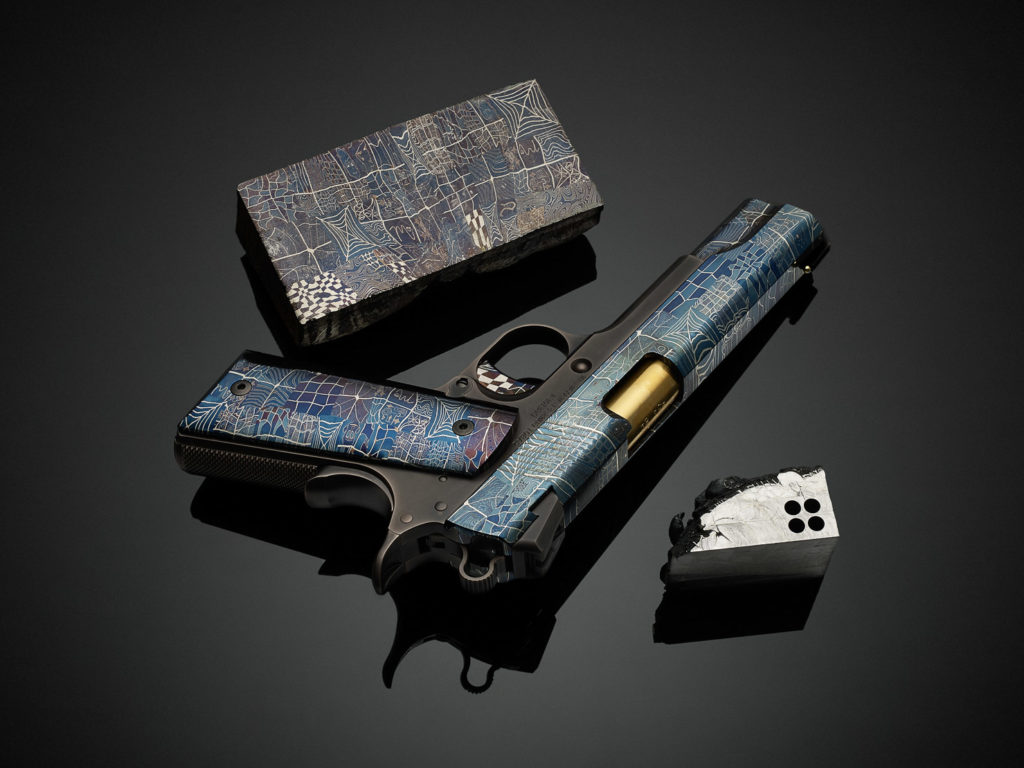
The flagship is the Jones 1911, named for master gunsmith Carl Jones. Around it orbits the material work that made Cabot famous. In 2013 the company produced what it describes as the first Damascus-steel 1911, and the line since has gone further: the Mosaic Damascus pistols, four guns built from a single billet of pattern-welded steel made by bladesmith Robert Eggerling. One billet, four pistols, more than a year in the making — the swirling pattern on each slide and frame is not a finish. It is the steel itself, folded and forged until the layers flow like grain in wood.
Damascus work is the visible half of the shop's personality: aerospace discipline on the inside, blacksmith's art on the outside. The same company that publishes thousandth-of-an-inch clearances also folds steel the way swordsmiths did a thousand years ago.
THE MOMENT
In 2016 Cabot unveiled the Big Bang Pistol Set: a matched pair of 1911s — one left-handed, one right-handed, true mirror images — machined from a 35-kilogram chunk of the Gibeon meteorite, an iron meteorite that fell over what is now Namibia in prehistoric times. The iron itself is older than the Earth: it cooled in space over billions of years before it ever fell.
Not everything can be meteorite. Barrels, springs, sears and pins in the Big Bang pistols are conventional steel, because a four-billion-year-old rock does not care about your recoil spring's service life. The structural gun — slide, frame, grips — is the meteorite. Cabot priced the set at $4.5 million when it was unveiled, which made the pair, at least on paper, the most expensive pistols ever offered.