
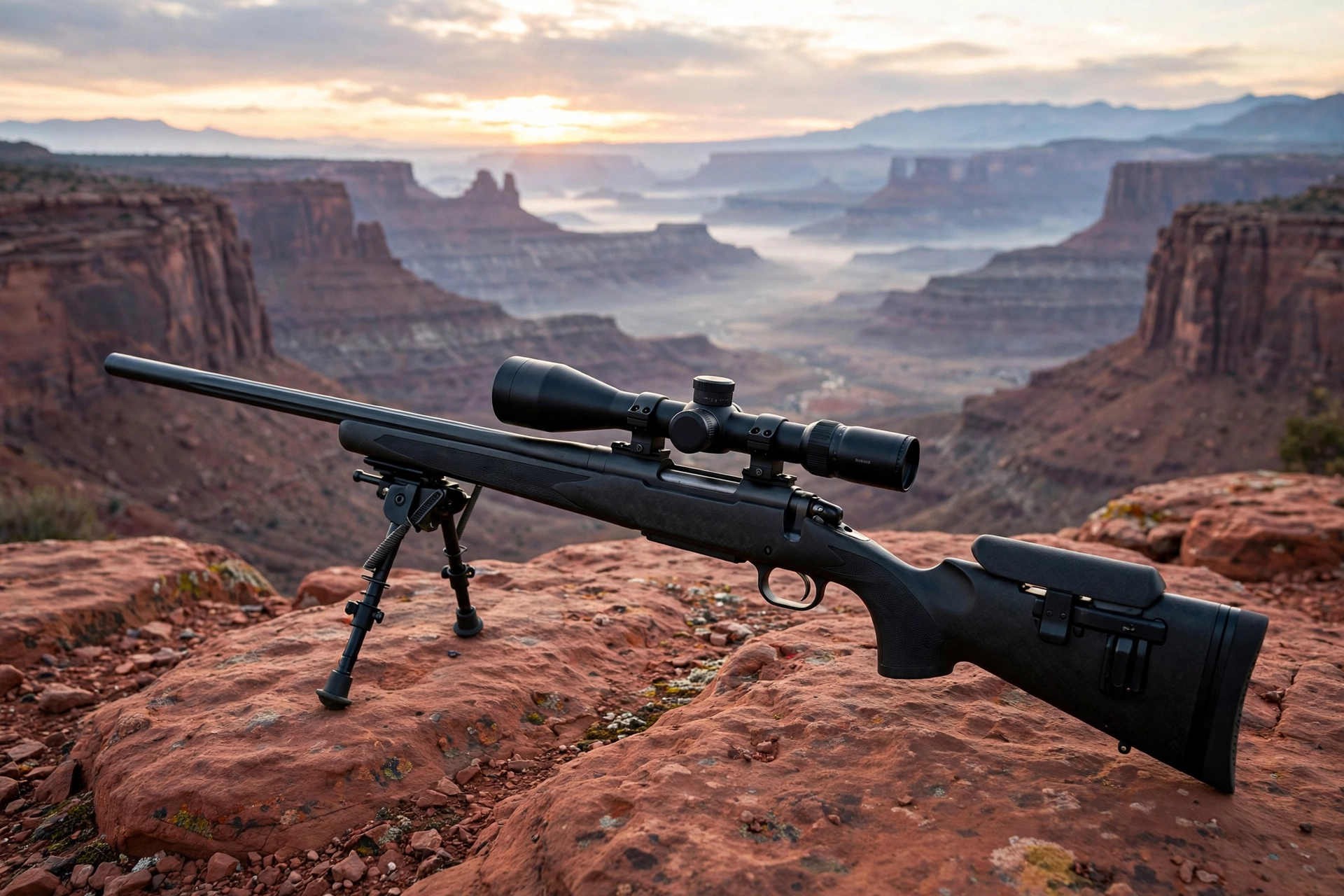
1,000 Yards: The Long-Range Primer
Wind, mirage and math — what it actually takes to stretch a rifle to four figures.
Every long-range education begins with the same humiliation, usually somewhere around 600 yards: the target is large, the rifle is excellent, the shooter is competent — and the bullet lands in the dirt, pushed sideways by a wind that was never announced and cannot be seen. Welcome to the discipline. Everything after that moment is the systematic elimination of excuses, and it is some of the most satisfying learning in all of shooting.
The primer version is short enough to write on a card. One: the rifle and ammunition must be consistent, verified by a chronograph, because math built on guesses stays guesses. Two: the scope must track truly, because a click that isn't a click corrupts everything downstream. Three: distance must be known, not estimated into optimism. And four — the one that takes years — the wind must be read, which means learning to see the world in moving grass, mirage, dust and flags, all at once, and converting it into a decision before the conditions change their mind.
The math is the easy half
Ballistic solvers have made the arithmetic trivial, and that is a gift with a catch. The solver will tell you exactly what the bullet does in the conditions you describe — but describing the conditions is the entire skill. A full-value wind at the muzzle, a quartering wind at the target, a canyon doing whatever it wants in between: the solver gets one number, and choosing that number is the shooter's whole job. This is why experienced long-range shooters talk about wind the way sailors talk about weather — as a presence, not a variable.
Position is the other quiet half. A rifle fired from a collapsing position delivers its data pre-corrupted, and no scope can subtract a wobble that was baked in. The primer's unglamorous core is therefore this: build a position you can stay in, manage recoil so you can see your own impact, and treat every shot as an experiment whose result you are obligated to observe.
What the desert teaches
Learn in big country and the lessons come with scenery. Mirage over red rock reads like print. Wind announces itself in dust a ridge away, if you've learned to look. And the feedback loop — the long pause while the bullet travels, the faint ring of steel arriving back like a letter from the shot you fired — teaches patience as a technical skill, not a virtue.
Four figures of distance stop being a number very quickly. They become a standard of honesty: about your equipment, your data, your position, and yourself. Zero shortcuts is not a slogan on this desk. It is a description of the physics, and physics, unlike the internet, cannot be argued with. It can only be learned — one humbled, exhilarated session at a time.